
Arab Weddings,
Beautifully
Explained.
An Arab wedding can be a drumline exploding through ballroom doors, a quiet marriage contract signed with family gathered close, a church crowning ceremony, a henna night that feels like its own wedding, or all of those things across one unforgettable weekend. This guide explains the traditions without pretending the Arab world celebrates in one way.
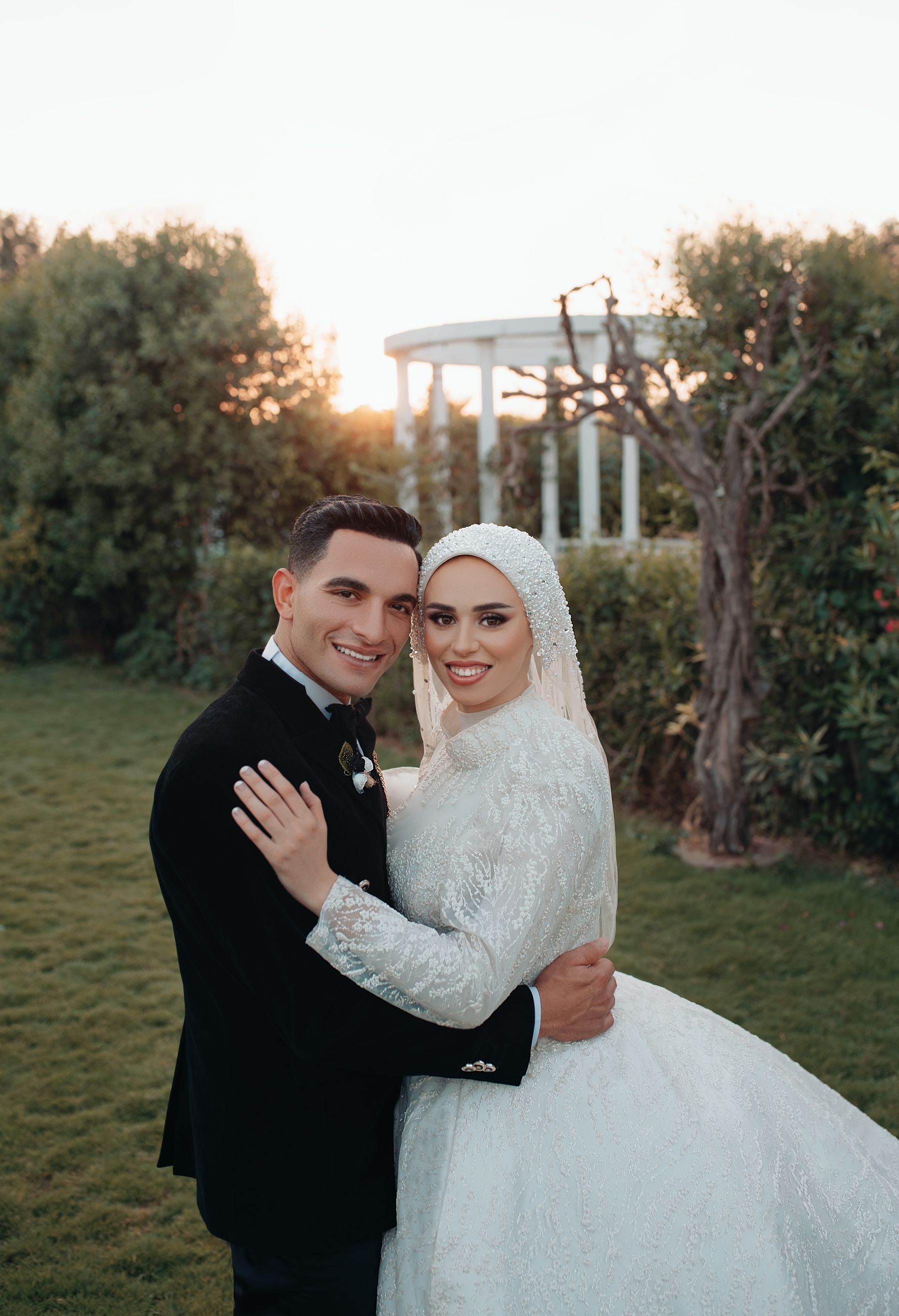
There is no single Arab wedding.
“Arab wedding” describes celebrations across more than twenty countries and a global diaspora. A Lebanese Maronite wedding, a Palestinian Muslim wedding, an Egyptian Coptic wedding, an Iraqi wedding in Baghdad, a Khaleeji celebration in the Gulf and a Moroccan wedding in Casablanca can look dramatically different.
Arab is also not a synonym for Muslim, and “Middle Eastern” is not a synonym for Arab. Persians, Turks, Kurds, Armenians and many other peoples of the region have distinct wedding cultures. The most useful question is not “What do Arabs do?” but “Where is this family from, what is their faith, and which traditions matter to them?”
The celebration often starts before the wedding.
Many Arab weddings unfold in chapters. Some families keep every gathering separate; others combine them into one weekend. Names, timing and meaning change across countries, and none of the events below should be treated as a universal checklist.
Khotbeh, tolbe or family engagement
In many families, marriage becomes public through a formal engagement or family gathering. In parts of the Levant, a tolbe or jaha can involve the groom’s family formally asking for the marriage and both families marking their agreement. Other families skip this formality entirely.
Henna night or pre-wedding celebration
Henna appears across many Arab societies, from Palestine and the Gulf to Egypt and the Maghreb, but the format changes enormously. It may be a women-centered night of singing and dress, a mixed party, a smaller family ritual, or absent altogether.
The marriage ceremony
For Muslim couples this may be a nikah or katb el-kitab centered on consent, witnesses and the marriage contract. Arab Christian couples may marry in church according to Coptic, Orthodox, Maronite, Melkite, Catholic, Protestant or other rites. Civil ceremonies may also be part of the legal process.
Zaffe or celebratory entrance
The newlyweds may be announced with drums, singers, dancers, ululation and a procession into the reception. The sound and staging vary by region: a Lebanese zaffeh is not identical to an Egyptian zaffa, and Gulf or North African processions have their own vocabularies.
Dinner, family and hospitality
The meal is not background. Generosity toward guests is central to many Arab celebrations, whether the menu is plated fine dining, a huge mezze spread, mansaf, quzi, machboos, seafood, Moroccan banquet dishes or a fusion menu built for a diaspora crowd.
Dancing that becomes the night
Once the floor opens, the reception can move between regional Arabic music, dabke or other folk dances, classic tarab, contemporary pop and the couple’s local favorites. At many diaspora weddings, English, French, Spanish or other music sits naturally beside Arabic sets.
The contract is the center. The party is separate.
For Muslim couples, the religious marriage is often called the nikah, katb el-kitab or aqd al-qiran, depending on country and family. The exact procedure varies by school of law, local law and community, but the ceremony is fundamentally about a valid marriage agreement—not a decorative performance for the reception.
A Muslim wedding can be Arab, South Asian, African, Turkish, Persian, Bosnian, Southeast Asian or something else entirely. “Nikah” describes an Islamic marriage ceremony, not an Arab ethnicity.
Consent
The bride and groom’s consent is central. How that consent is expressed, documented and witnessed can vary by community and jurisdiction.
Mahr
The marriage contract includes a mahr, a gift or financial obligation from the groom to the bride. Families may discuss it privately before the ceremony or state it during the signing.
Witnesses & officiant
An imam, sheikh or authorized officiant may lead the ceremony, though requirements differ across legal and religious traditions. The atmosphere can range from intimate and quiet to a large seated event.
Qur’an, du’a & blessings
Recitation and prayer often frame the contract, with elders and relatives offering congratulations afterward. Some families host the katb el-kitab weeks or months before the main reception.
Walima
Walima refers to the wedding feast in Islamic tradition. In real life it can mean anything from lunch after the contract to the full-scale ballroom reception, depending on the family.
Modesty & celebration style
Some weddings are fully mixed with music and dancing; others separate men and women, limit instruments, avoid alcohol or structure the evening differently. Do not assume religiosity from nationality—or nationality from the format of the party.
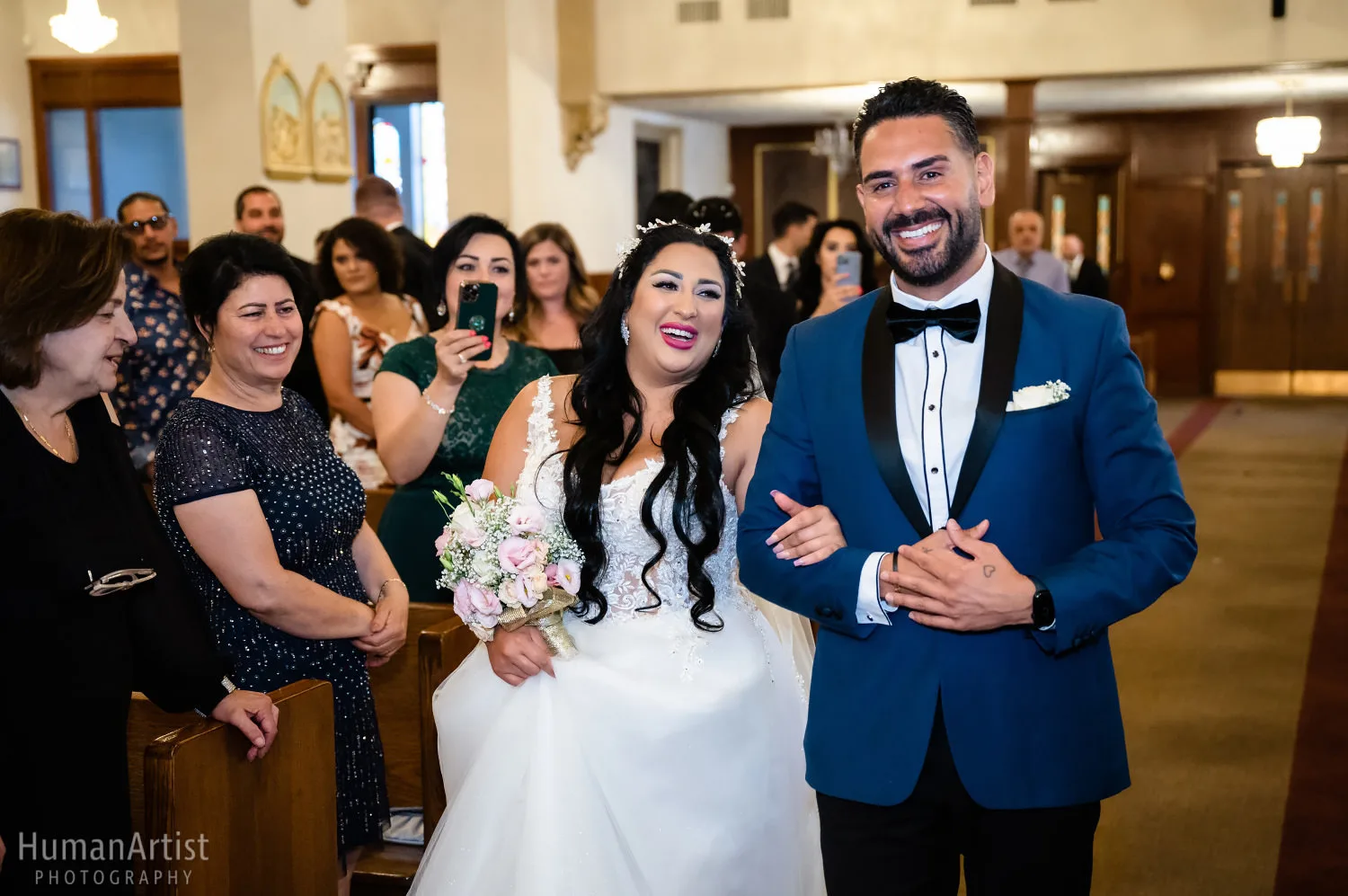
Arab does not mean one faith.
Arab Christian wedding traditions are as old and regionally rooted as Muslim ones. In Lebanon, Palestine, Jordan, Syria, Egypt and Iraq, couples may belong to Maronite, Greek Orthodox, Coptic Orthodox, Syriac, Melkite, Chaldean Catholic, Roman Catholic, Protestant and other churches.
The ceremony follows the couple’s church rather than an “Arab wedding script.” Orthodox traditions may include crowns; Coptic and other Eastern churches have their own liturgies, readings and blessings; Maronite and Catholic weddings center sacramental vows in church. Afterward, the reception can look unmistakably regional: zaffe, dabke, Arabic music, family tables and the same loud joy found across the community.
This is one reason reception customs should not be used as a shortcut for guessing religion. A drum-led Lebanese entrance or Palestinian dabke line can belong just as naturally to a Christian couple as a Muslim one.
From Beirut to Baghdad, Cairo to Casablanca, details matter.
The Arab world is too large for one wedding template. These snapshots are starting points—not recipes—and families within the same city can celebrate differently.
Lebanon, Palestine, Syria & Jordan
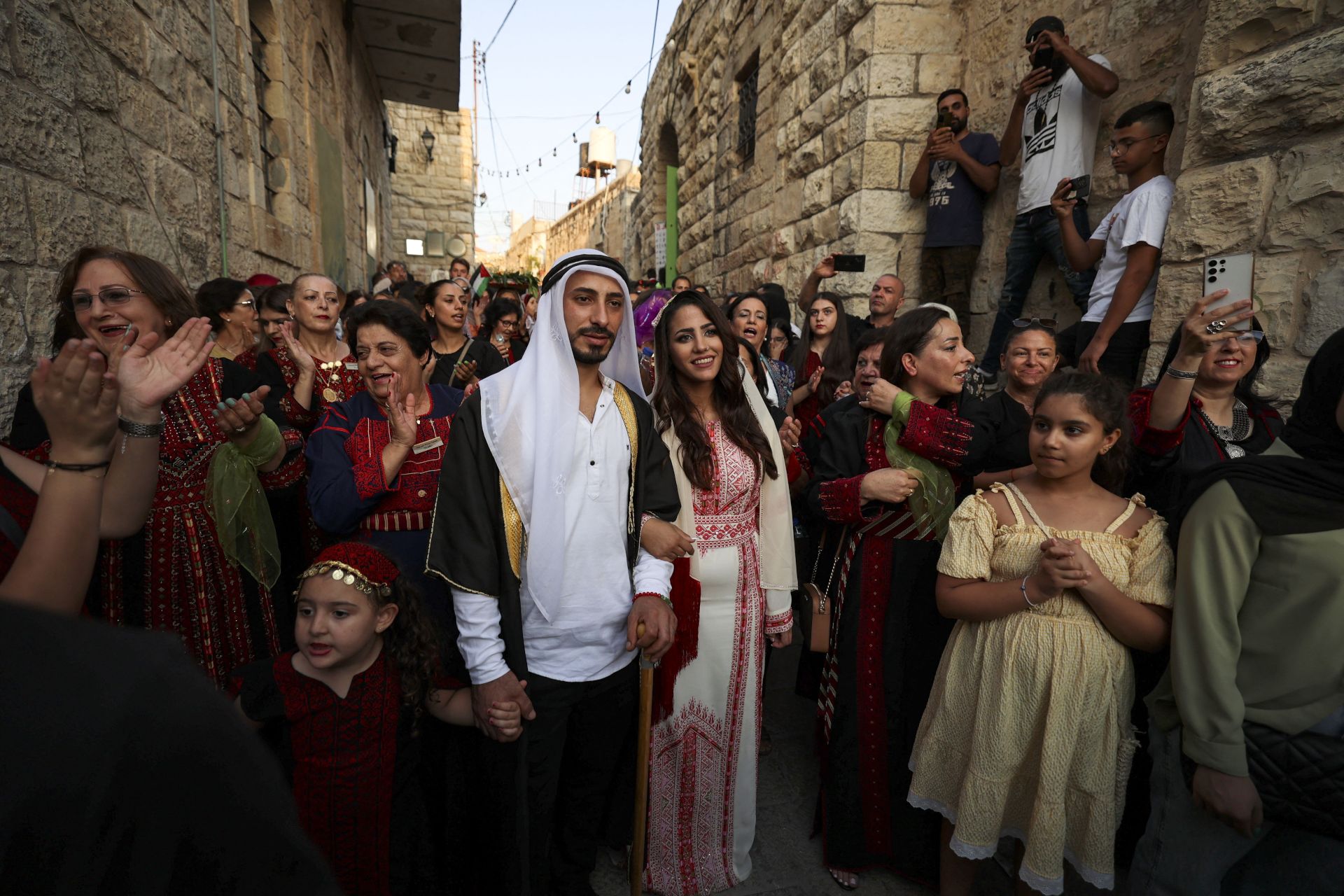
Zaffe, dabke, zaghareet, family processions and big communal dance floors are especially visible here. Palestinian weddings may foreground embroidered thobes and tatreez; Jordanian families may serve mansaf; Lebanese receptions often lean toward high-production entrances and late-night dancing.
Egyptian weddings
The Egyptian zaffa has its own unmistakable energy: tabla, mizmar, singers, dancers and a theatrical entrance. Urban weddings may also center a decorated kosha or stage, elaborate bridal fashion and a reception that moves quickly from formal photos to an all-night party.
Iraqi weddings
Iraqi celebrations bring together Arabic, Kurdish, Turkmen, Assyrian and other community influences. Music and dance can include chobi and regional songs, while menus may feature quzi, dolma and other Iraqi favorites. Religious traditions differ across Muslim and Christian families.
Khaleeji weddings
Across Saudi Arabia, Kuwait, Bahrain, Qatar, the UAE and Oman, some families host separate men’s and women’s celebrations, while others host mixed receptions. Henna, perfume, jewelry, regional dress, live singers and highly produced women’s halls can all play major roles.
Morocco, Algeria & Tunisia
North African Arab weddings carry strong Amazigh, Andalusi, Mediterranean and local influences. Morocco is famous for caftans, takchitas, the negafa and amariya; Algerian and Tunisian weddings have their own dress changes, henna rituals, music and multi-day family customs.
Arab weddings abroad
In Los Angeles, Detroit, London, Toronto, Sydney, Paris and beyond, weddings often compress old and new into one schedule: church or katb el-kitab, bilingual emcee, zaffe, Arabic dinner music, Western first dance, dabke, then a multilingual open format party.

The entrance is not an entrance. It is an announcement.
Zaffe, zaffa and zaffeh are spelling variations for a wedding procession found across the Arab world. In 2025, UNESCO inscribed “the zaffa in the traditional wedding” on the Representative List of the Intangible Cultural Heritage of Humanity across several participating countries.
What makes a zaffe powerful is not one costume or instrument. It is the public transition: family, musicians, dancers and guests physically move the couple into the celebration. Depending on the region, you might hear darbuka or tabla, frame drums, mizmar, vocals, call-and-response chants or a modern recorded track reinforced by live percussion.
For planners, the logistics matter almost as much as the music. A good zaffe needs a route wide enough for performers, a clear handoff into the dance floor, lighting that can follow motion, and photographers positioned before the doors open. Ten minutes of chaos can become the most remembered ten minutes of the wedding—or just chaos.
There is no such thing as one “traditional Arab dress.”
Modern white bridal gowns and tuxedos are common across the Arab world, but heritage clothing remains central in many families—especially at henna nights, pre-wedding events and regional ceremonies.
Modern bridal fashion
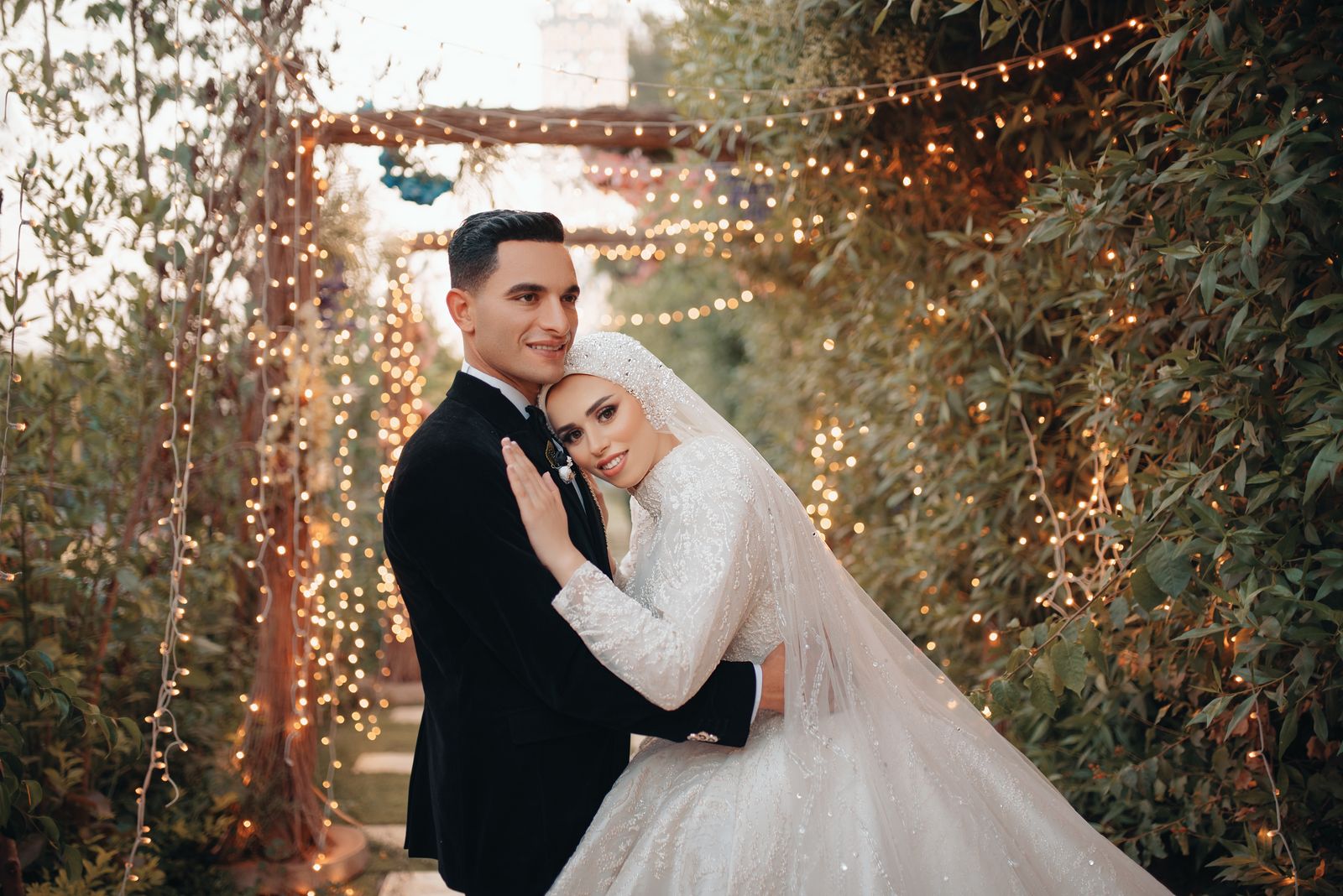
Arab brides often treat the wedding gown as high fashion: structured couture, dramatic veils, intricate beadwork and editorial beauty looks. Modest silhouettes, long sleeves and covered necklines can be religious choices, personal style choices—or both.
Palestinian thobe & tatreez
Palestinian embroidered dress carries local history in its motifs, stitches and regional styles. A bride may wear a thobe for henna, portraits, a procession or part of the reception, sometimes pairing heritage clothing with a white gown later.
Moroccan caftan & takchita
Moroccan brides may change through multiple richly embroidered looks guided by a negafa, the bridal dresser and ceremony specialist. Caftans, takchitas, belts, crowns and jewelry make the wardrobe itself part of the event’s choreography.
Khaleeji celebration wear
Gulf wedding fashion can include couture evening gowns, regional embroidered dresses, jalabiyas, abayas and significant gold jewelry. Women-only celebrations may allow a completely different fashion atmosphere from the public ceremony.
Grooms
Tuxedos and dark formal suits are common, while bishts, thobes, jabadors and other regional garments may appear for ceremonies, entrances or portraits. The right choice is the groom’s actual family tradition—not a generic “Middle Eastern” costume.
Guest dress
Many Arab weddings are formal and guests dress boldly. Jewel tones, evening gowns and sharp tailoring are common, but the invitation should lead. Religious venues may call for covered shoulders, longer hemlines or head-covering guidance.
Some of the deepest wedding culture happens before the ballroom.
Henna nights can be intimate, enormous, traditional, modern or skipped entirely. What they often preserve is a social space where women sing, dress, bless the bride and pass down the parts of wedding culture that are hardest to put into a timeline spreadsheet.
More than body art
Across North Africa, Egypt, the Levant, Iraq and the Gulf, henna can mark preparation, blessing and celebration. Designs, who applies them, what the bride wears and whether the groom participates all depend on local custom.
The sound of joy
Zaghareet—or the singular zaghrouta—are high, wavering ululations heard at weddings and other major celebrations across the Arab world. They can erupt at the contract signing, the bride’s entrance, the zaffe, a dance-floor peak or a family blessing.
Memory carried by voice
Wedding songs often survive because aunts, grandmothers and cousins keep singing them. Some are tied to a village or city; some travel across borders; others become new diaspora versions with Arabic and English woven together.

Hospitality is part of the ceremony.
The best Arab wedding menus feel specific. “Middle Eastern buffet” is not a cuisine. A family from Amman, Alexandria, Baghdad, Beirut, Jeddah or Fez has its own food memory, and the menu can tell that story before anyone reaches the dance floor.
Three menu rules worth keeping
Feed people generously. Guest counts can be large, dinner may come late, and dancing can run for hours. Underfeeding the room is remembered.
Name the regional dishes. A menu card that says “Jordanian mansaf” or “Iraqi quzi” gives non-Arab guests context and gives family members the pleasure of seeing their food represented accurately.
Respect alcohol choices. Some Arab weddings serve full bars, some are alcohol-free, and some separate drinking from religious portions of the day. There is no universal “Arab wedding” rule.
Dabke is iconic. It is not universal.
Dabke is a Levantine folk line dance strongly associated with Lebanon, Palestine, Syria and Jordan. Guests link hands or shoulders, step and stamp together, and follow a leader who can improvise at the head of the line. At the right wedding, the dabke line can absorb half the room.
But Arab dance culture is much bigger than dabke. Iraqi chobi, Egyptian popular dance styles, Gulf/Khaleeji rhythms, Moroccan and Algerian traditions, live oud, qanun, violin, tabla, darbuka, mizmar and modern Arabic pop all have different places in different weddings.
A strong diaspora DJ does not play “Arabic music” as one block. They understand region, generation and language: old Fairuz or Abdel Halim for one table, dabke anthems for the cousins, a contemporary Lebanese or Egyptian hit for the younger crowd, then the couple’s American, French, Latin or global favorites without making the night feel like two separate weddings.
Come dressed up. Come curious. Follow the family.
You do not need to know every word in Arabic or every step of dabke. Good guest etiquette is mostly about reading the invitation, respecting the ceremony and joining the celebration without turning someone else’s culture into a performance.
Match the energy
- Dress for the stated formality; Arab weddings are often more dressed-up than a typical Western cocktail reception.
- Bring a wrap or choose modest clothing when attending a mosque, church or conservative family ceremony.
- Join the dance floor when invited. If dabke starts, stand toward the middle of the line and follow before trying to lead.
- Learn the family’s preferred country and community terms instead of calling everything “Middle Eastern.”
- Expect warm hospitality and a lot of family introductions. Weddings are social networks in motion.
Assume one Arab rulebook
- Do not assume an Arab wedding is Muslim—or that a Muslim wedding is Arab.
- Do not assume there will be alcohol, mixed dancing, gender separation or no gender separation. Follow the event in front of you.
- Do not wear religious or nationalist symbols as costume pieces because they “match the theme.”
- Do not call every procession “Lebanese” or every line dance “dabke” when the family identifies it differently.
- Do not leave immediately after dinner unless the invitation says the event is ending. The party may just be getting started.
Make it culturally specific, not generically “Middle Eastern.”
The strongest diaspora weddings do not force every tradition into one night. They identify the moments that actually belong to the couple, then design the venue, timeline, music and guest experience around them.
Map the family first
Write down country, city, religion, language, regional dance traditions and the relatives who hold ceremonial roles. “Lebanese” or “Arab” alone is rarely enough detail for a vendor team.
Design the zaffe route
Measure the hallway, doors and dance floor. Confirm open-flame, sword, drum and special-effect rules with the venue. Build a staging area so performers are not improvising behind a catering station.
Build the music by region
Give the DJ a cultural map, not a 300-song dump: family classics, regional must-plays, dabke or chobi songs, modern Arabic favorites, do-not-plays and the non-Arab music that matters to the couple.
Plan bilingual moments
A short Arabic-and-English welcome, translated ceremony program or bilingual emcee can make grandparents and non-Arab guests feel equally included without turning the wedding into a lecture.
Protect religious boundaries
If the katb el-kitab, church ceremony, women-only room, prayer time or alcohol policy has firm rules, communicate them to vendors before the event—not five minutes before guests arrive.
Let fusion be precise
A Palestinian-Mexican, Lebanese-French or Egyptian-American wedding is strongest when each culture gets recognizable moments of its own, followed by places where the couple intentionally brings them together.
Arab wedding culture deserves specific language.
This guide cross-checks wedding terminology with cultural institutions, specialist reporting and regional sources, and deliberately separates Arab identity, religion and geography. Customs evolve quickly in the diaspora, so the family getting married remains the final authority on its own traditions.
The questions people actually ask.
What happens at an Arab wedding?
There is no universal sequence. Depending on the couple, an Arab wedding may include a formal engagement or tolbe, henna, a Muslim katb el-kitab or Christian church ceremony, a zaffe procession, dinner, speeches, dabke or another regional dance, cake and a long reception. Country, religion and family tradition matter more than any generic checklist.
What is a zaffe?
A zaffe—also spelled zaffa or zaffeh—is a celebratory wedding procession. It may include drums, singers, dancers, mizmar, swords, candles, zaghareet and a choreographed entrance, but the exact style varies by country. Lebanese, Egyptian, Gulf and North African versions should not be treated as identical.
Are all Arab weddings Muslim?
No. Arab communities include Muslims, Christians and other faiths. Christian Arabs may marry in Maronite, Coptic, Orthodox, Melkite, Catholic, Protestant or other church traditions, then celebrate with regional customs such as zaffe, dabke and Arabic music.
What is katb el-kitab?
Katb el-kitab is a common Arabic term for the signing or formalization of a Muslim marriage contract. Depending on the country and family, people may also call the ceremony nikah or aqd al-qiran. It may happen privately, at a mosque, at home or as a large wedding event.
What is dabke?
Dabke is a Levantine folk line dance associated especially with Lebanon, Palestine, Syria and Jordan. Dancers link hands or shoulders and move through rhythmic steps, often with a leader improvising at the front. It is iconic at many Levantine weddings, but it is not the universal dance of every Arab country.
What should I wear to an Arab wedding?
Follow the invitation first. Many Arab weddings are formal, black-tie or highly dressed-up events. Rich color and eveningwear are common. For religious venues, dress modestly and follow instructions about head coverings or shoulders. Traditional clothing is best worn when the couple welcomes it and you understand what you are wearing.
How long does an Arab wedding last?
Some couples host one ceremony and reception; others celebrate across multiple days or gatherings. A diaspora couple might hold a henna night on Friday, church or katb el-kitab on Saturday, and a reception the same evening. The main party itself can also run late into the night.
Do Arab weddings have alcohol?
Some do and some do not. Religion, family preference, venue and country all matter. Never assume an Arab wedding is dry, and never assume it has an open bar. The invitation and hosts are the only reliable guide.
Is a Middle Eastern wedding the same as an Arab wedding?
No. The Middle East includes Arab and non-Arab peoples. Persian, Turkish, Kurdish, Armenian and other wedding traditions have their own languages, histories and rituals. “Arab wedding” is appropriate when the couple identifies with an Arab culture; “Middle Eastern” is broader and less specific.
Planning an Arab wedding?
Tell us what you need and we’ll match your wedding with vetted Arab wedding vendors from our network.
Get matched with Arab wedding vendors.
Choose the services you need. We’ll check our pool of vetted Arab wedding vendors for fit and availability, then get back to you with a custom proposal.
- 01Choose your services.
- 02We check vetted Arab vendors.
- 03Get your custom proposal.