
Russian weddings are not one fixed script.
A Russian wedding can mean state registration at ZAGS, an Orthodox venchanie, a modern restaurant reception, family customs inherited from a specific region—or a mix of all four. The useful way to understand it is to separate what is legal, what is religious, and what is simply a tradition a family chooses to keep.
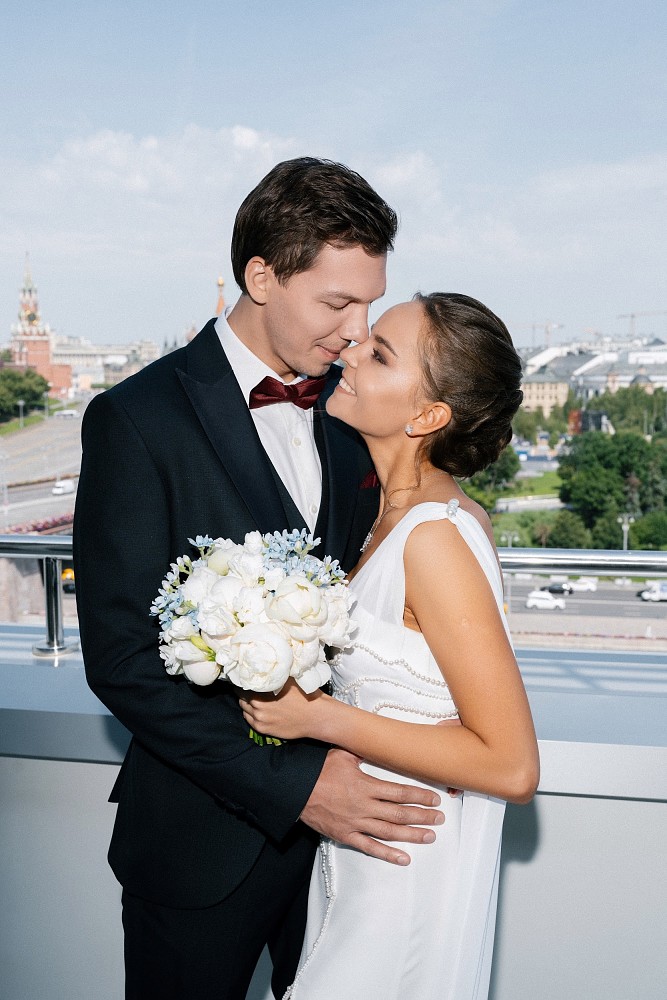
Three layers people often mix together.
Articles about “Russian wedding traditions” often mash together the Russian legal system, Orthodox Christianity and folk customs as though every couple follows one national ceremony. They do not.
In Russia, the legal act is state registration of the marriage. An Orthodox wedding is a separate religious sacrament. Bread-and-salt, Gorko!, bride-ransom games, family blessings and banquet customs sit in a third category: they are cultural practices whose form and importance change by region, family and generation.
State registration
In the Russian Federation, marriage is registered as a civil-status act. A couple can choose a simple registration or, where available, a more ceremonial setting.
ЗАГС · ZAGSOrthodox Crowning
For Orthodox couples who meet parish requirements, the church service includes Betrothal, Crowning, a common cup and a threefold procession.
ВЕНЧАНИЕ · VENCHANIYEFamily & reception customs
Karavai, bread and salt, Gorko!, playful ransom customs, toasts and reception style are traditions—not a mandatory national checklist.
СВАДЬБА · SVADBA
The heart of the service is the Crowning.
The Orthodox marriage rite is not a Western ceremony with personal vows added to an icon-filled setting. Its structure and theology are different. The Orthodox Church in America describes a sequence of Betrothal, Crowning, common cup, threefold procession, removal of the crowns and final blessing.
- 01Betrothal
Rings are exchanged as a sign of commitment and devotion. - 02Crowning
Crowns are placed on or held above the couple. Russian/Slavic practice commonly uses imperial-style crowns. - 03Common cup
The couple drinks from one cup, expressing the life they will share. - 04Threefold procession
The priest leads the couple around the central table three times—their first ceremonial steps together as husband and wife. - 05No Western-style personal vows
The Orthodox rite does not center on the couple reciting personal marriage vows to one another.
Parish eligibility, preparation, photography, music and attire rules vary. Couples should confirm the actual requirements with the priest who will celebrate the wedding.
The church wedding and the legal marriage are not the same event.
Russia’s official ZAGS portal states that marriages are among the civil-status acts registered by the state under federal law. The law also allows the registration to be conducted in a ceremonial setting if the couple wishes.

Keep the meaning. Lose the fake rules.
Russian wedding customs developed differently from one region to another, and many older rites were far more elaborate than the simplified versions seen at modern receptions. These are traditions you may encounter—not requirements every Russian couple is expected to perform.
Bread and salt / karavai
historic + still usedParents may welcome the newlyweds with a decorated ceremonial loaf and salt. Historically, bread carried ideas of abundance and prosperity, while the greeting also marked the bride’s welcome into a new household. The exact presentation varies sharply by region and family.
“Gorko!”
reception customGorko means “bitter.” Folkloric records describe guests calling the wine bitter and requiring the newlyweds to kiss to “sweeten” it. Today it may happen once, repeatedly, jokingly—or not at all.
Vykup — bride ransom
historic ritual · now often playfulOlder wedding rites included forms of “ransom” around access to the bride, her braid, the gate, a seat or other ritual moments. A modern vykup is usually a comic pre-ceremony game with riddles, small challenges, sweets, drinks or symbolic money—not a literal purchase of the bride.
Parental blessing
family / religious variationIn many regional traditions, parents blessed the couple with icons, bread and salt, or spoken words before or after the church rite. Some Orthodox families still treat this as emotionally central; secular families may reinterpret it or skip it completely.
The wedding walk
modern city patternAfter registration, many couples build time for portraits around city landmarks before the reception. In places such as Saint Petersburg, wedding photography at recognizable monuments has become a visible part of modern city wedding culture, even though it is not an ancient sacramental custom.

One tradition with many regional versions.
Karavai is a decorated ceremonial loaf found across Russian and broader East Slavic wedding traditions. Historical Russian examples place bread-and-salt at moments of blessing, welcome and transfer between households.
That does not mean every modern family performs the same “take a bite and whoever gets the bigger piece rules the household” routine. Those game-like versions exist, but they are not the definition of the tradition.
For a diaspora wedding, the best question is simple: How did your parents or grandparents actually do it? That answer is more useful than a generic internet checklist.
A real tradition with a better history than the usual one-line explanation.
Culture.ru, drawing on Russian folkloric sources, documents the wedding-table custom of calling the wine “bitter” so the newlyweds must kiss and “sweeten” the moment. Nineteenth-century lexicographer Vladimir Dal recorded the same basic idea.
Older explanations connect the contrast between bitter and sweet to a wider wedding language of separation, transition, love and marriage—not just a drinking game.
Modern etiquette: if the couple hates repeated public kissing, the host should control the tradition rather than letting guests turn it into an all-night command.
The host matters. The word “tamada” needs context.
Older English-language guides often write as though every Russian wedding is run by a “tamada.” That is too broad. The word is widely understood across the post-Soviet world and has strong Caucasus associations. In today’s Russian event industry, couples very often hire a ведущий / vedushchiy—literally a host or presenter.
A good modern host manages entrances, family acknowledgments, speeches, humor, games if wanted, transitions and the pace of dinner without making the night feel like a six-hour variety show.
At a Russian-American or multilingual wedding, the harder skill is bridging generations: knowing when Russian is useful, when English is enough, how to introduce a tradition in ten seconds, and when to get out of the DJ’s way.
The old “tamada = mandatory Russian wedding tradition” line is exactly the kind of lazy cultural shorthand this page should avoid.
.jpg?width=2200)
Warmth works better than an open microphone.
Toasts can be a major part of Russian and Russian-speaking wedding receptions, but “everyone must give a long poetic speech” is another overstatement. Modern couples increasingly curate who speaks and when.
A smart timeline protects the emotional part of the tradition without sacrificing the whole evening: parents and grandparents early, close friends later, short translation only when needed, and no surprise ten-minute speeches between every course.
Translate the meaning, not every word
A short summary in the second language keeps the room connected without turning every toast into two speeches.
Set boundaries before dinner
Know the speaking order, approximate length and who should never be surprised with a microphone.
Think banquet logic, not one “Russian menu.”
Russian wedding food varies by region, family background, venue and generation. What is more consistent is a sense of abundance: guests should not feel as though dinner disappeared after one plated entrée.

“Play Russian music” is not a useful DJ brief.
A Russian-speaking guest list can span Soviet-era favorites, 1990s/2000s pop, current Russian-language music, Western pop, house, hip-hop, rock, Jewish, Armenian, Ukrainian, Georgian, Central Asian or other family influences. The nationality label alone tells the DJ almost nothing.
What guests should actually check.
Skip the fake universal rules. The invitation, the couple and the parish are better sources than a generic “Russian wedding etiquette” list.
- Orthodox ceremony: arrive on time and follow the parish’s instructions for attire, movement and photography.
- Dress code: treat the couple’s stated dress code as authoritative; “all Russian weddings are ultra-formal” is not a rule.
- Gifts: cash gifts are common in many families, but registries and other formats are also normal in diaspora weddings. Follow the couple’s guidance.
- Gorko: do not assume the couple wants guests repeatedly demanding kisses. Let the host set the tone.
- Language: nobody expects non-Russian-speaking guests to understand every toast or song. Participate warmly and ask rather than pretending.
- Church customs: head coverings, candle handling and other practices can vary by parish; do not present one church’s local custom as a universal rule.
You do not need two weddings inside one ballroom.
The goal is not to give each family an isolated cultural block. A better wedding makes key traditions understandable to everyone and then lets the party feel like one room.
Bilingual where it changes the experience
Translate entrances, parent acknowledgments and essential instructions. Do not repeat every sentence in full unless your guests genuinely need it.
Choose three meaningful moments
A family blessing, bread-and-salt welcome and one Gorko moment can feel more authentic than ten internet customs nobody in the family recognizes.
Blend instead of segregating
Move between cultures based on tempo, familiarity and crowd response rather than building separate “Russian” and “American” hours.
Ask what they would miss
The fastest way to identify the real traditions is to ask each family what would make the wedding feel incomplete if it disappeared.
Eight decisions to make before the timeline is locked.
This is the planning work that prevents cultural details from becoming last-minute surprises.
The questions worth answering carefully.
Legal and religious rules can change or vary by jurisdiction and parish. Confirm those details with the authority actually handling your marriage.
What is the difference between ZAGS and an Orthodox wedding?
ZAGS refers to the civil-status registration system through which marriages are legally registered in Russia. An Orthodox venchanie is a church sacrament. Couples may have both, but they are not interchangeable.
What happens during a Russian Orthodox wedding?
The service includes the Betrothal with rings, Crowning, prayers and scripture, a common cup and a threefold procession around the central table, followed by removal of the crowns and a blessing. Orthodox rites do not use Western-style personal vows.
What does “Gorko!” mean?
Gorko means “bitter.” In the wedding-table tradition, the newlyweds kiss to “sweeten” what guests have declared bitter. Modern couples may encourage, limit or omit it.
What is karavai?
Karavai is a decorated ceremonial bread used in Russian and other East Slavic traditions. At weddings it can appear with bread-and-salt greetings or blessings, but the ritual varies by family and region.
Is bride ransom still a real Russian wedding tradition?
Forms of wedding “ransom” are historically documented. Modern vykup is usually a playful pre-ceremony activity using jokes, challenges, sweets, drinks or symbolic money. Many couples skip it entirely.
Is the Russian wedding MC called a tamada?
Sometimes, but not always. Tamada is widely understood across the post-Soviet world and carries broader Caucasus and old-school banquet associations. Modern Russian couples very commonly use vedushchiy or vedushchaya for a professional wedding host.
What food is traditional at a Russian wedding?
There is no single mandatory menu. Shared starters or zakuski, salads, hot meat or fish dishes, bread, fruit, desserts and cake are all plausible banquet elements. Family background and venue matter more than a fixed national list.
How should we plan a Russian-American wedding?
Choose traditions your families actually recognize, explain unfamiliar moments briefly, plan language intentionally, hire vendors who understand the reception style, and blend music rather than separating cultures into blocks.
Build your wedding with vendors who understand the family, language and flow.
Tell us what you need. We’ll check our vetted Russian wedding vendor network and build a custom proposal around your ceremony, traditions and reception.
Get matched with Russian wedding vendors.
Choose the services you need. We’ll check our pool of vetted Russian wedding vendors for fit and availability, then get back to you with a custom proposal.
- 01Choose your services.
- 02We check vetted Russian vendors.
- 03Get your custom proposal.
Editorial references
Fact-checked against the official Russian ZAGS portal, the Orthodox Church in America’s wedding-ceremony outline, and Culture.ru’s folkloric history of “Gorko!” and Russian wedding customs. Photography is credited individually to Dennis G. Jarvis, Viktoriya Zlykh, Strumskaya ella, Olli Niemitalo, Ralf Steinberger and Timothy Post via Wikimedia Commons under the licenses shown. Image presentation on this page may crop photographs responsively.