
Jewish
Weddings
A clear guide to what actually happens at a Jewish wedding — the ketubah, bedeken, chuppah, rings, seven blessings, broken glass, yichud, hora, food, family customs and the differences that matter from one community to another.

A Jewish wedding is a structure for meaning — not one fixed script.
The recognizable pieces are easy to list: a ketubah, a chuppah, wine, rings, seven blessings, a glass underfoot and a room full of people yelling “Mazel tov.” What makes Jewish weddings interesting is that those pieces can be arranged very differently depending on who the couple is and where their families come from.
An Orthodox Ashkenazi wedding in Brooklyn may include separate pre-ceremony receptions, a tisch, a bedeken, a traditional Aramaic ketubah and separate dancing. A Sephardi or Mizrahi family may bring in henna, regional liturgy, Mediterranean or Middle Eastern music and different ceremony customs. A Reform, Reconstructionist, Conservative, interfaith or secular Jewish couple may keep the chuppah and sheva brachot while adapting the ring language, circling, ketubah text or officiation.
That variety is not a footnote. It is the central fact to understand. “Jewish wedding” describes a shared ritual vocabulary used by many communities, not a single universal production.
If you are planning one, start with your family and officiant before you start with Pinterest. Decide which customs are religious requirements for you, which are family traditions, and which simply feel beautiful.
First ask: whose Jewish wedding?
The biggest source of confusion online is a tradition from one community being presented as a rule for everyone. These four lenses explain most of the variation you will encounter.
Ashkenazi, Sephardi, Mizrahi — and more
Families carry different customs from Central and Eastern Europe, Iberia, North Africa, the Middle East, Iran, Yemen, Central Asia and beyond. Music, food, pre-wedding rituals, pronunciation and even the order of small ceremony details can change.
Religious practice changes logistics
Orthodox and other traditionally observant weddings may follow halachic requirements closely, including witness rules, Shabbat timing, kosher catering and gender-separated dancing. Liberal Jewish weddings often adapt these practices in egalitarian ways.
Family minhag can matter more than trends
Minhag means custom. Two families from the same broad background may still do things differently because a practice has been handed down in one family and not the other.
Modern couples make deliberate choices
Many couples share ring language, circle one another, use an egalitarian ketubah, invite family to recite blessings, include English readings or combine Jewish ritual with another culture’s wedding traditions.
Your rabbi or cantor is part of the design team
Bring clergy in early. They can tell you what is required within your movement or community, what can be adapted, how long each ritual takes and which wedding dates will or will not work.
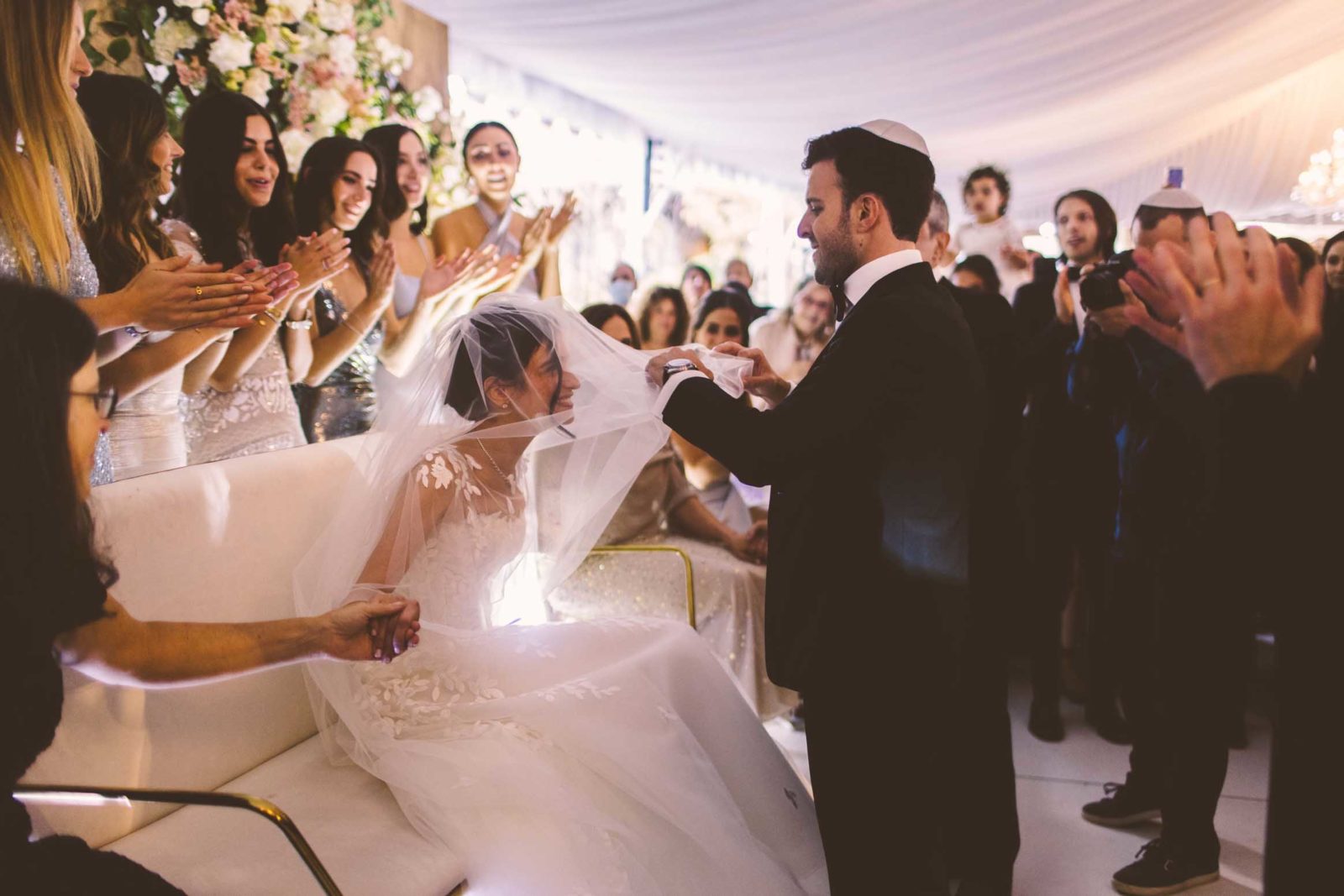
The wedding may begin before guests take their seats.
At more traditional weddings, some of the most emotionally charged moments happen before the chuppah. At other weddings, the same rituals are condensed into one intimate ketubah signing with immediate family.
- 01Kabbalat panim: a pre-ceremony reception welcoming the couple. In traditional settings, bride and groom may receive guests separately.
- 02Tisch: at many Ashkenazi Orthodox weddings, the groom gathers with guests for singing, Torah words, toasts and wedding-document business before the ceremony.
- 03Ketubah signing: the marriage contract is signed by witnesses before the chuppah. Many contemporary couples make this its own mini-ceremony because the document is both legal history and personal art.
- 04Bedeken: in communities that practice it, the groom veils the bride shortly before the chuppah. The custom is associated with biblical stories of Rebecca and of Jacob, Leah and Rachel.
Photography note: the ketubah and bedeken can move quickly and happen in tight rooms. Give your photographer the exact order in advance; these are not moments to discover in real time.
Two ancient stages, now usually one ceremony.
The traditional Jewish marriage ceremony brings together two legal stages that were historically separated in time: kiddushin (betrothal/sanctification) and nissuin (nuptials). Today they normally happen back-to-back under the chuppah.
Processional & chuppah
The couple enters with family and stands beneath the canopy. In some Ashkenazi communities the bride circles the groom three or seven times; many contemporary couples circle each other or skip the custom.
Wine, blessing & ring
Blessings are recited over wine. In a traditional ceremony the groom gives the bride a ring in the presence of valid witnesses and says the marriage formula. Egalitarian ceremonies may exchange rings and reciprocal language.
Reading the ketubah
The ketubah is read between kiddushin and nissuin. The public reading marks the transition from the first stage of marriage to the second.
Sheva brachot
The seven wedding blessings move from wine and creation to human life, Zion, companionship and the joy of the couple. Different people may be honored with reciting individual blessings.
Breaking the glass
A glass is broken at the end, immediately releasing the room from solemnity into celebration. The sound is followed by applause and a chorus of “Mazel tov!”
Yichud
In many traditional weddings the couple spends a few private minutes together immediately after the ceremony. Practically, it is also their first chance to sit, breathe and eat something before the reception starts.

The ceremony keeps returning to home, memory and joy.
Jewish wedding rituals are compact, but they carry several layers of meaning at once. These are the symbols guests notice most.
An unfinished home
The canopy is commonly understood as the home the couple is building. Its open sides make hospitality visible: this new household belongs to the couple, but it is not closed off from family and community.
Joy made ceremonial
Wine appears in both major stages of the ceremony. A blessing turns an ordinary drink into a ritual marker, separating one sacred moment from the next.
A simple object with legal weight
Traditional Jewish law centers the act of giving and accepting an item of value before witnesses. Many traditional communities use a plain, unbroken ring; liberal ceremonies often include reciprocal exchange.
The couple inside a much larger story
The seven blessings do not stay narrowly focused on romance. They widen outward to creation, humanity, community, Jerusalem and collective joy.
Joy with memory inside it
The best-known interpretation recalls the destruction of the Temple in Jerusalem: even at a peak of personal happiness, collective memory is not erased. Other interpretations emphasize fragility and irreversible change.
Public ritual gives way to privacy
After a ceremony witnessed by a whole community, the couple steps away from everyone else. That small reversal is one reason yichud can feel unexpectedly moving.
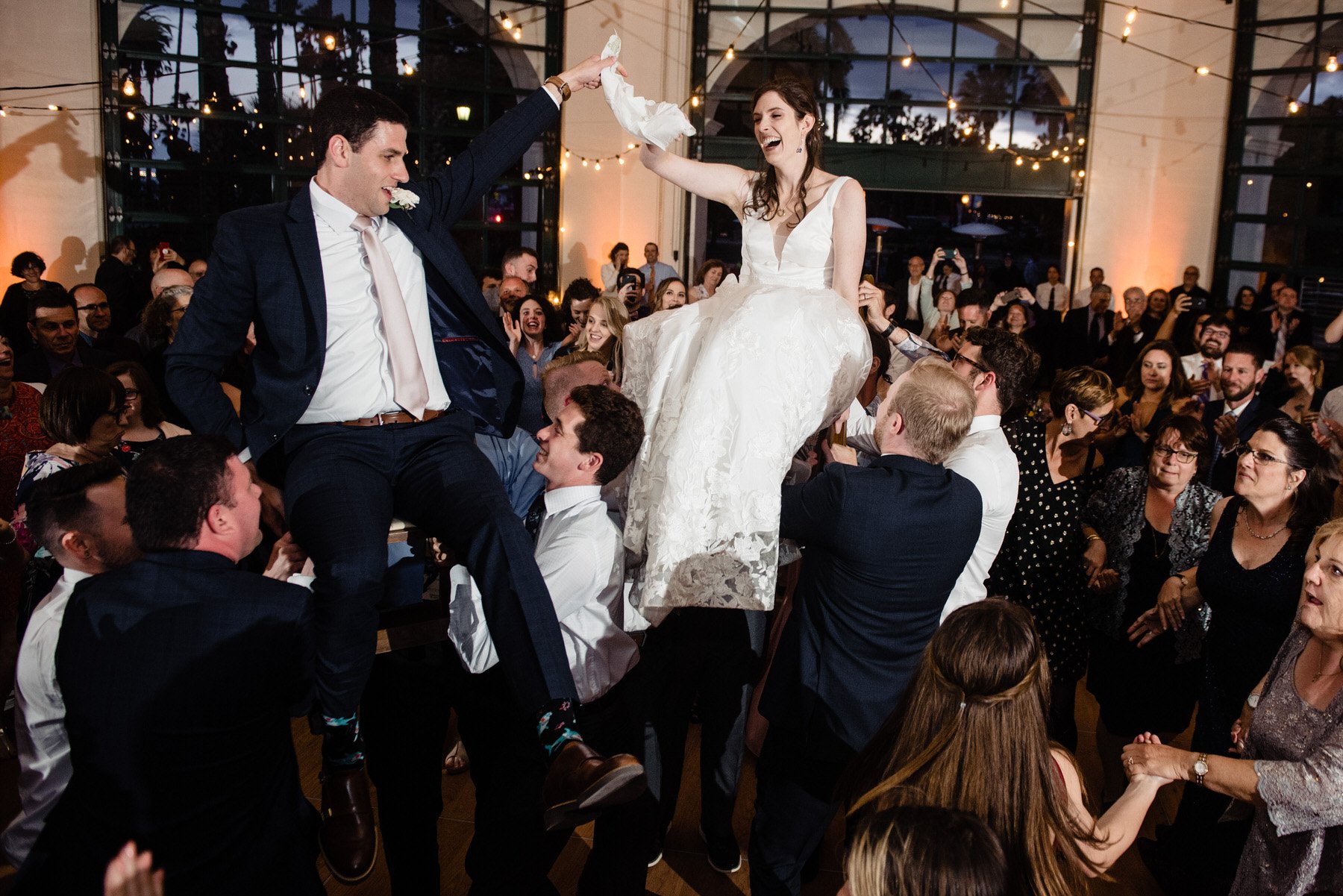
The hora is not background music. It is organized chaos.
At many Jewish receptions, circle dancing pulls several generations onto the floor at once. The famous chair lift is only one part of it. The better description is communal participation: guests are not watching the couple celebrate; they are physically creating the celebration around them.
- 01Timing matters: many couples start the hora early, often right after the grand entrance, while grandparents and the full guest list are still present.
- 02Space matters: chair lifts and growing circles need a clear dance floor. Tiny cocktail tables at the perimeter become obstacles fast.
- 03Community changes the format: some Orthodox weddings use separate men’s and women’s circles divided by a mechitzah; liberal weddings generally dance together.
- 04Music goes beyond “Hava Nagila”: a strong Jewish dance set may include Hebrew, Israeli, klezmer, Hasidic, Sephardi, Mizrahi or family-specific repertoire before crossing into mainstream party music.
“Jewish wedding food” depends on which Jewish family.
There is no universal Jewish reception menu. An Ashkenazi family may expect challah, brisket, salmon, kugel or Eastern European comfort food. A Persian Jewish wedding may serve jeweled rice and kebabs. A Syrian, Moroccan, Iraqi, Bukharian or Yemeni family may build dinner around an entirely different culinary memory.
The planning question is often less “What dishes are Jewish?” and more “Does the wedding need to be kosher, and according to whose standard?” If kosher observance matters, the caterer, kitchen, supervision, wine and even outside desserts may need approval.
Venue shortcut: do not sign a catering contract first and ask about kosher requirements later. If religious supervision is important, it can affect kitchens, rentals, staffing, deliveries and outside-vendor rules.
One wedding language, many accents.
A useful way to plan is to separate core ceremony structure from community customs. The examples below are common, not universal.
- AAshkenazi: you may see a tisch, bedeken, bride circling the groom, a groom in a white kittel, Yiddish or Hebrew songs, klezmer influence and — in some families — a mezinke dance honoring parents when their last child marries.
- SSephardi: ceremony wording, ketubah reading and pre-wedding customs can differ from Ashkenazi practice. Families may bring musical and culinary traditions from Spain, the Balkans, North Africa and the Mediterranean.
- MMizrahi: Jewish communities from the Middle East and surrounding regions carry distinct Iraqi, Iranian, Yemeni, Syrian, Kurdish and other customs. “Mizrahi” is not one wedding style.
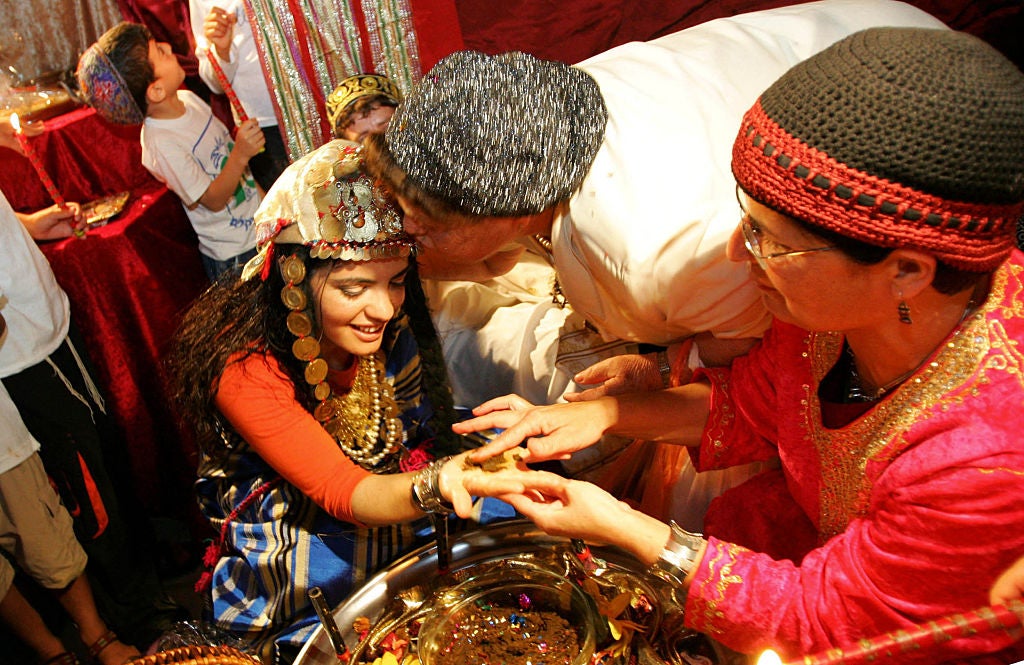
- HHenna: some Moroccan, Algerian, Iraqi, Iranian, Yemeni and other Middle Eastern or North African Jewish families hold a henna celebration before the wedding, often with traditional clothing, music, sweets and blessings.
Do not flatten Sephardi and Mizrahi weddings into “Mediterranean Jewish.” Ask where the family is actually from. Moroccan, Persian, Syrian, Iraqi and Bukharian celebrations can have completely different music, food and ritual expectations.
Check the Jewish calendar before the venue calendar.
This is one of the most practical differences between planning a Jewish wedding and a generic venue event. In traditional practice, certain dates are simply unavailable for weddings.
Friday evening through Saturday night
Traditional Jewish weddings are not held on Shabbat. Saturday-night weddings are popular after Shabbat ends; the exact start time moves with sunset and location, so “7 PM every Saturday” is not a safe planning rule.
Major festivals affect availability
Traditional practice avoids weddings on major Jewish holidays such as Rosh Hashanah, Yom Kippur, Passover, Shavuot and parts of Sukkot. Clergy schedules may be restricted even when a venue is open.
Omer and Three Weeks customs vary
Many traditional communities avoid weddings during parts of the Omer and during the Three Weeks before Tisha B’Av. The exact practice differs by community, which is why the officiant should confirm the date.
Practical rule: if the wedding is observant, call the rabbi before paying a non-refundable venue deposit. If it is a Saturday-night wedding, build the timeline from the actual end of Shabbat in that city on that date.
How to be a good guest at a Jewish wedding.
You do not need to know Hebrew or understand every ritual. The useful etiquette is mostly about paying attention to the family’s level of observance and joining the celebration when invited.
Take the cue at the entrance
At many ceremonies men are offered kippot, and some synagogues or communities have additional expectations. If they are provided, wearing one is a respectful and easy choice.
Modesty varies by community
Black tie may mean fashion-forward eveningwear at one wedding and more covered shoulders, necklines or hemlines at another. The invitation, venue and family are your best clues.
Do not rush the “Mazel tov”
Wait for the glass to break and the room to erupt. That sharp transition from ceremony to celebration is part of the experience.
Follow the room
At a hora, join the circle if you are comfortable. At an observant wedding, dancing may be separated by gender; do not treat the mechitzah like a curiosity or try to cross it for a better video.
Shabbat rules may matter
At some weddings, photography or phone use is restricted during Shabbat or sacred parts of the event. If hosts ask for a camera-free ceremony, take it seriously.
“Mazel tov” is enough
You do not need a Hebrew speech. A warm congratulations, enthusiasm on the dance floor and respect for the rituals will carry you a long way.
Build the timeline around ritual, not just reception logistics.
The difference between a smooth Jewish wedding and a generic timeline with Jewish elements pasted onto it is usually coordination. The officiant, planner, DJ/band, photographer, caterer and venue need the same sequence.
Confirm the ceremony model first
Ask the officiant which rituals are required, optional or adaptable in your community. That answer determines the document, witnesses, timing and physical setup.
Give the ketubah real time
Signing can involve witnesses, clergy, close family and photos. Do not squeeze it into the five minutes before the processional.
Design the chuppah for people, not just photos
Confirm enough room for the couple, officiant, parents and anyone reading blessings. Check wind, candle rules, microphone placement and sightlines.
Plan the hora like an event inside the event
Choose the timing, clear the floor, identify sturdy armless chairs, tell the photographers where the lift will happen and make sure the band or DJ knows the family’s repertoire.
Resolve kosher and Shabbat rules early
These are infrastructure decisions, not styling decisions. They can determine the venue, caterer, staffing, schedule and which vendors can work.
Find vendors who already understand Jewish weddings.
Cultural fluency is not about forcing every wedding to look traditional. It means vendors know what is about to happen, why it matters and where they need to be before anyone has to explain it.
Jewish Wedding DJs
Hora pacing, Hebrew and Jewish music, introductions, family cues and multicultural dance floors.
↗Jewish Wedding Planners
Timelines built around ketubah, bedeken, chuppah, yichud, kosher requirements and family customs.
↗Jewish Wedding Photographers
Photographers who anticipate the bedeken, ring, glass, chair lift and fast-moving family moments.
↗Kosher & Jewish Caterers
From strict kosher supervision to culturally specific Ashkenazi, Sephardi, Mizrahi and Israeli menus.
↗Jewish Wedding Venues
Spaces that can handle chuppah setup, kosher catering, Saturday-night load-in and large dance circles.
↗Rabbis & Officiants
Clergy and officiants for Orthodox, Conservative, Reform, Reconstructionist, interfaith and personalized ceremonies.
Questions people ask all the time.
There are exceptions to almost every short answer below. When a question affects religious validity or observance, follow your officiant and community practice.
What are the main traditions at a Jewish wedding?
Common elements include a ketubah, chuppah, blessings over wine, ring ceremony, sheva brachot, breaking a glass and a celebratory reception. Many weddings also include a bedeken, circling, yichud and hora, but the exact combination varies.
What is the difference between a chuppah and a Jewish wedding ceremony?
Technically, a chuppah is the wedding canopy, but people also use “the chuppah” as shorthand for the ceremony itself. The couple stands beneath it for the marriage rituals.
Does the bride always circle the groom seven times?
No. Circling is common in many Ashkenazi communities, often three or seven times, but it is not universal. Contemporary couples may circle each other, circle together or omit the custom.
Who signs the ketubah?
Traditional Jewish law requires two witnesses who meet specific religious qualifications. Contemporary ketubot may also include signatures from the couple, clergy or additional witnesses. Your officiant should confirm exactly who signs your version.
Why are there seven blessings?
The sheva brachot connect the marriage to larger themes: wine, creation, humanity, communal continuity, Jerusalem and the joy of the couple. They are recited under the chuppah and, in traditional practice, again after festive meals.
What should a non-Jewish guest expect?
You may hear Hebrew, be offered a kippah, watch rituals that are not explained in detail and then move very quickly into dancing. Follow the hosts’ cues. No one expects you to know the choreography or prayers.
Are all Jewish weddings kosher?
No. Some are strictly kosher under rabbinic supervision, some use kosher-style menus, and some have no dietary restrictions. The couple’s level of observance determines the requirement.
Can an interfaith couple have a Jewish wedding?
Many interfaith couples build ceremonies around a chuppah, ketubah and Jewish blessings, but officiation policies differ substantially among rabbis and Jewish movements. Contact potential clergy early rather than assuming every officiant follows the same policy.
How long is a Jewish wedding ceremony?
Many chuppah ceremonies run roughly 20–40 minutes, but a traditional ceremony with processional, circling, ketubah reading, blessings and remarks can be longer. Pre-ceremony ketubah, tisch and bedeken time is separate.
Build your wedding with vendors who already understand the culture.
Tell us what you need. We’ll check our vetted Jewish wedding vendor network and build a custom proposal around your ceremony, community and celebration.
Get matched with Jewish wedding vendors.
Choose the services you need. We’ll check our pool of vetted Jewish wedding vendors for fit and availability, then get back to you with a custom proposal.
- 01Choose your services.
- 02We check vetted Jewish vendors.
- 03Get your custom proposal.
Editorial note: Jewish wedding practice varies by community, family and movement. This guide was researched using educational material from My Jewish Learning, ReformJudaism.org, and Chabad.org. Couples should confirm religious requirements, witness rules, kosher standards and permitted wedding dates with their own officiant.